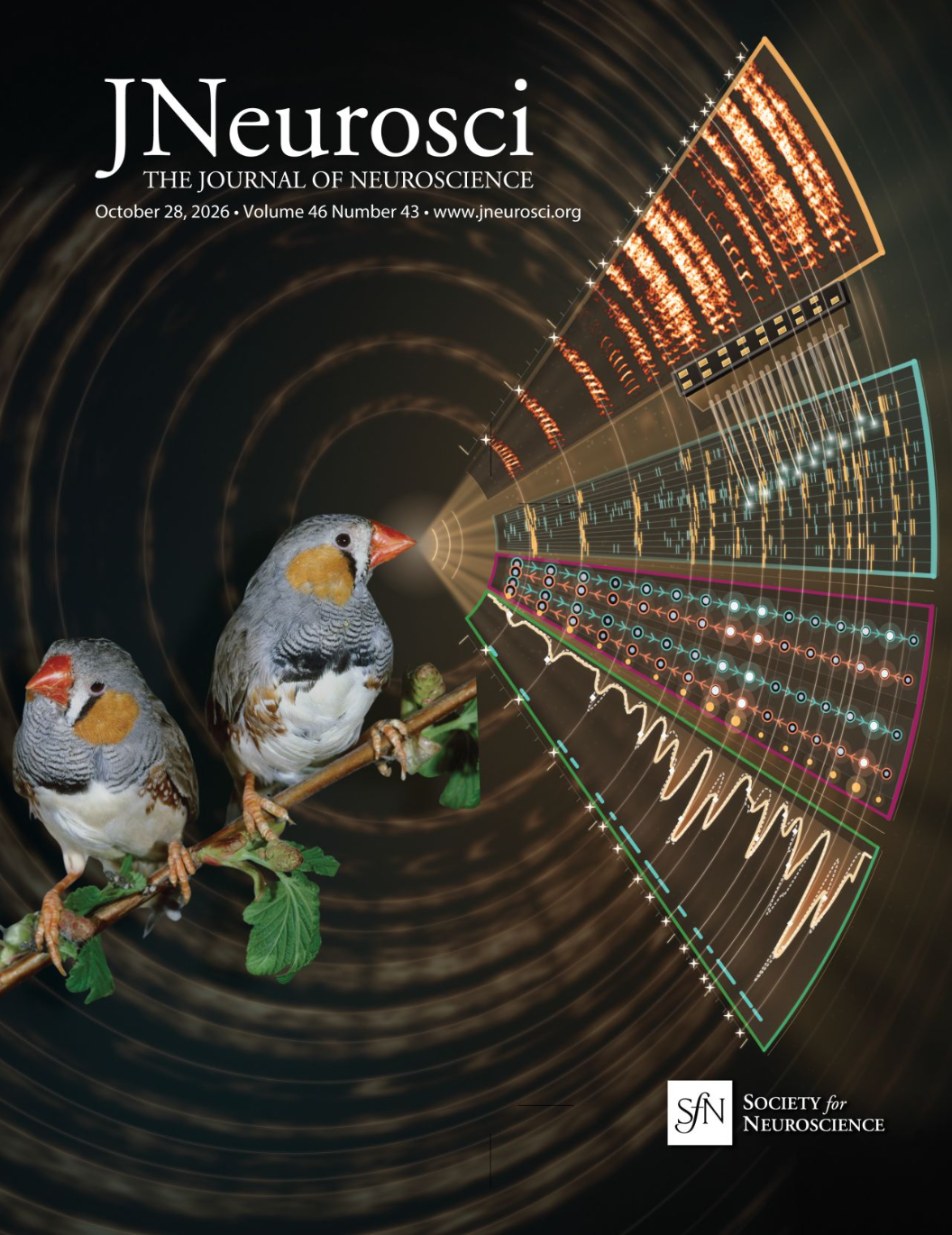

From Computational Models to Neural Circuits
Sheetal Jadhav · Supervisor: Dr. Raghav Rajan
Abstract
Songbirds have been a beneficial model organism for studying learned complex behaviors. They show a unique behavioral trait of being able to vocalize a song as a part of their courtship ritual. The young bird learns the song, similar to how humans learn the language. This learning from experience (auditory feedback from the father) shapes the precise motor circuits required to sing a song and potentially attract mates. The song in itself has a highly stereotyped structure. The neural structures and pathways involved in producing and learning the song have been well characterized by electrophysiological studies. Additionally, models of song learning, production, and sequence generation have widely helped advance the field and discover the underlying mechanisms and nuances in synaptic connectivity. Such models and experiments have given us a holistic picture of the avian brain.
Introduction
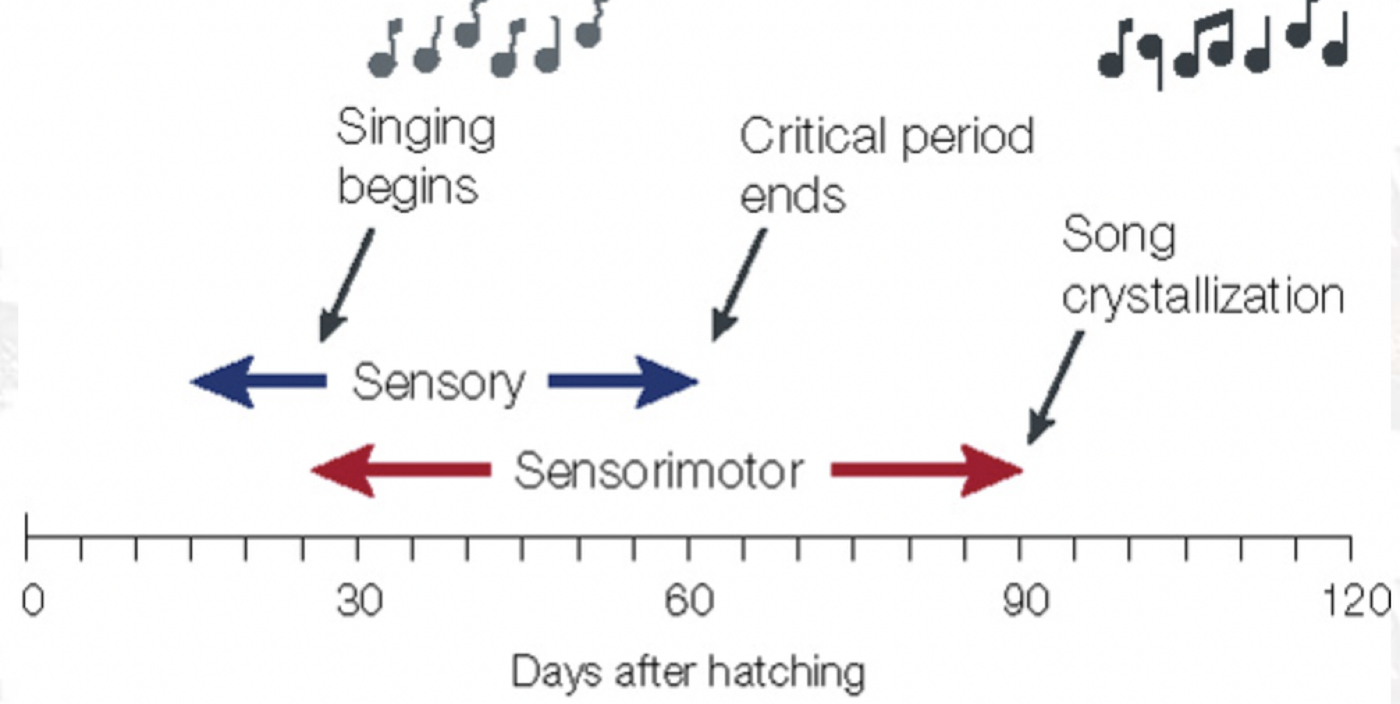
Innate behaviors are genetically pre-programmed throughout the developmental process. However, complex learned behaviors require genes and experience to form motor circuits. The ability to speak, sing and compose music, cook, drive or play sports is a complex learned behavior, learned by observing others and continuous practice of smaller, simpler sub-tasks or elements (Doupe 1999). This strategy of generating new behaviors creates a rich repertoire of actions, which has been built from a few building blocks. The broad idea of how these behaviors or actions are learned and encoded in the brain remains an age-old interesting question still open to be cracked completely. The songbird is an excellent model organism for studying motor circuits involved in complex learned action sequences(Doupe 1999; Jarvis 2007). All songbirds learn their songs/vocalizations by imitating a tutor, which in most cases is the father or other males of the colony. The song learning process is primarily divided into two parts: the sensory phase or a sensory learning phase that lasts from 0-60 days post-hatch, where the juvenile listens and stores a template of the tutor’s song. If the young bird is entirely isolated,i.e., does not have a tutor song input, the bird will have poorly structured themes. Next is the sensorimotor or motor learning phase, in which the juvenile starts babbling around day 25 post-hatch and requires auditory feedback from its own song to match the stored template and refine the song, which gets crystallized around 90 days or so (Fig1). After the song is crystallized, its structure has minimal change(“Dynamics of the Vocal Imitation Process: How a Zebra Finch Learns Its Song | Science” n.d.). The most common songbird used is Zebra Finch, which has a highly stereotyped song sequence, consistent over all the song bouts, making this repetitiveness helpful to do multiple experiments. Other songbirds, such as Bengalese Finch, Canaries, and hummingbirds, have also been studied widely.
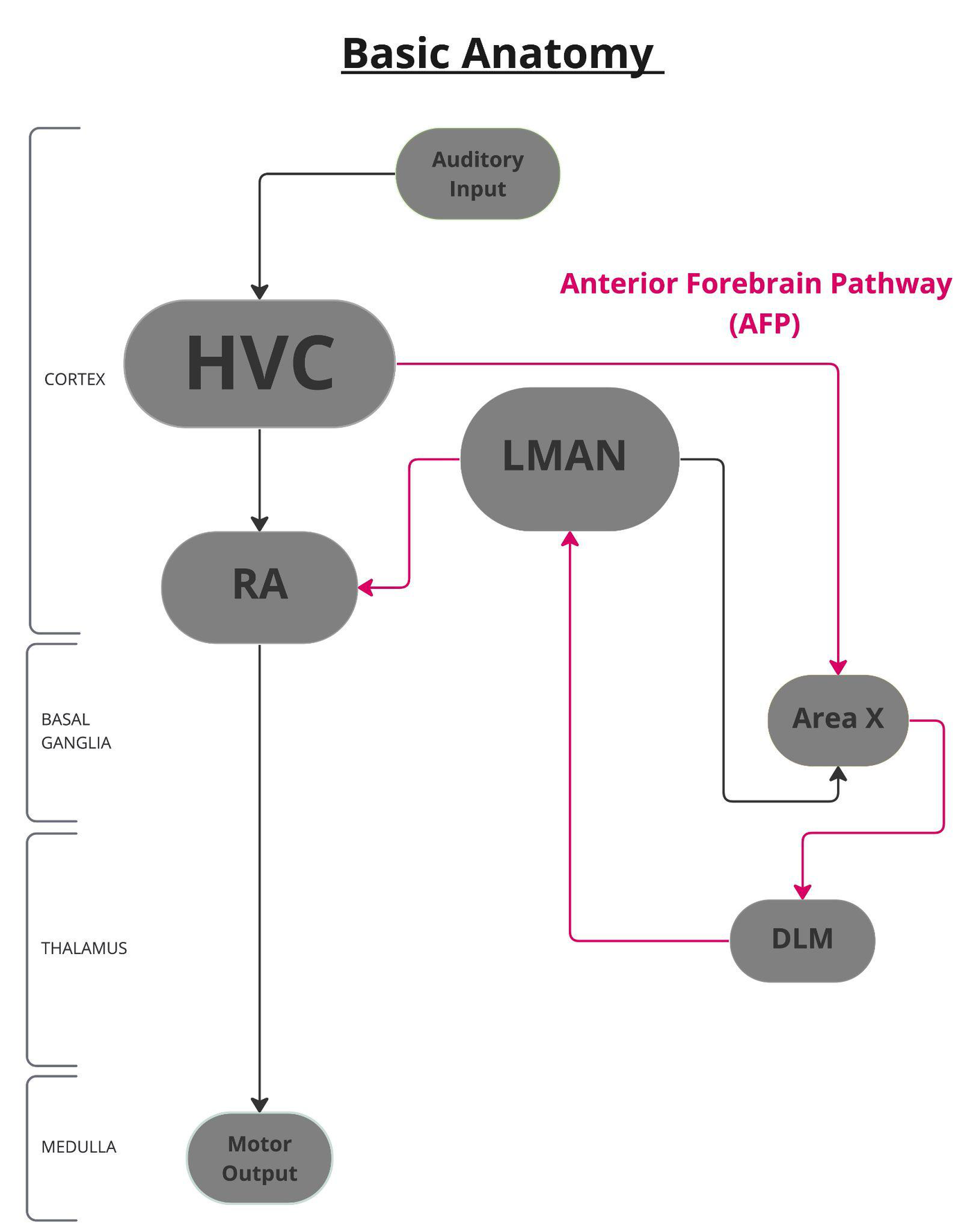
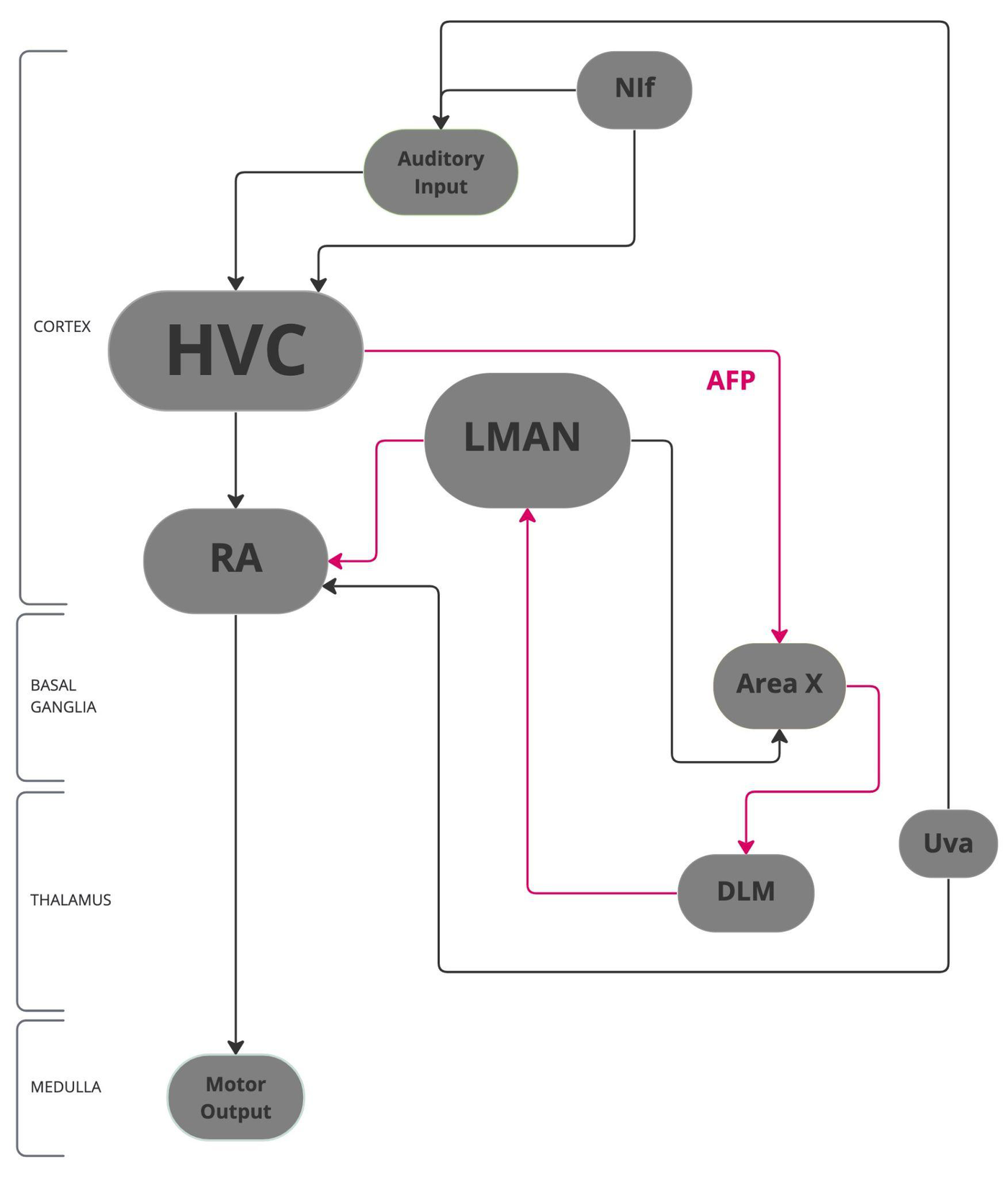
The brain areas required for songbirds’ vocalizations have been characterized well. As shown in a very simplified manner in Fig2, the auditory input likely from upstream cortical areas projects to HVC, which further projects to RA, finally controlling the nXIIts and the syrinx muscles to vocalize. This is the main motor pathway responsible for the song’s production and learning (Nottebohm, Stokes, and Leonard 1976). Lesions to HVC or RA disrupt normal song production at all stages of song development (Nottebohm, Stokes, and Leonard 1976; Simpson and Vicario 1990). However, HVC also projects to Area X forming a loop such as HVC-AreaX-DLM-LMAN-A. This pathway is called the Anterior Forebrain Pathway (highlighted with red arrows). A whole set of lesion studies from Bottjer, Miesner, and Arnold 1984; Scharff and Nottebohm 1991 indicate AFP is involved in learning the song but not required for song production in adults.
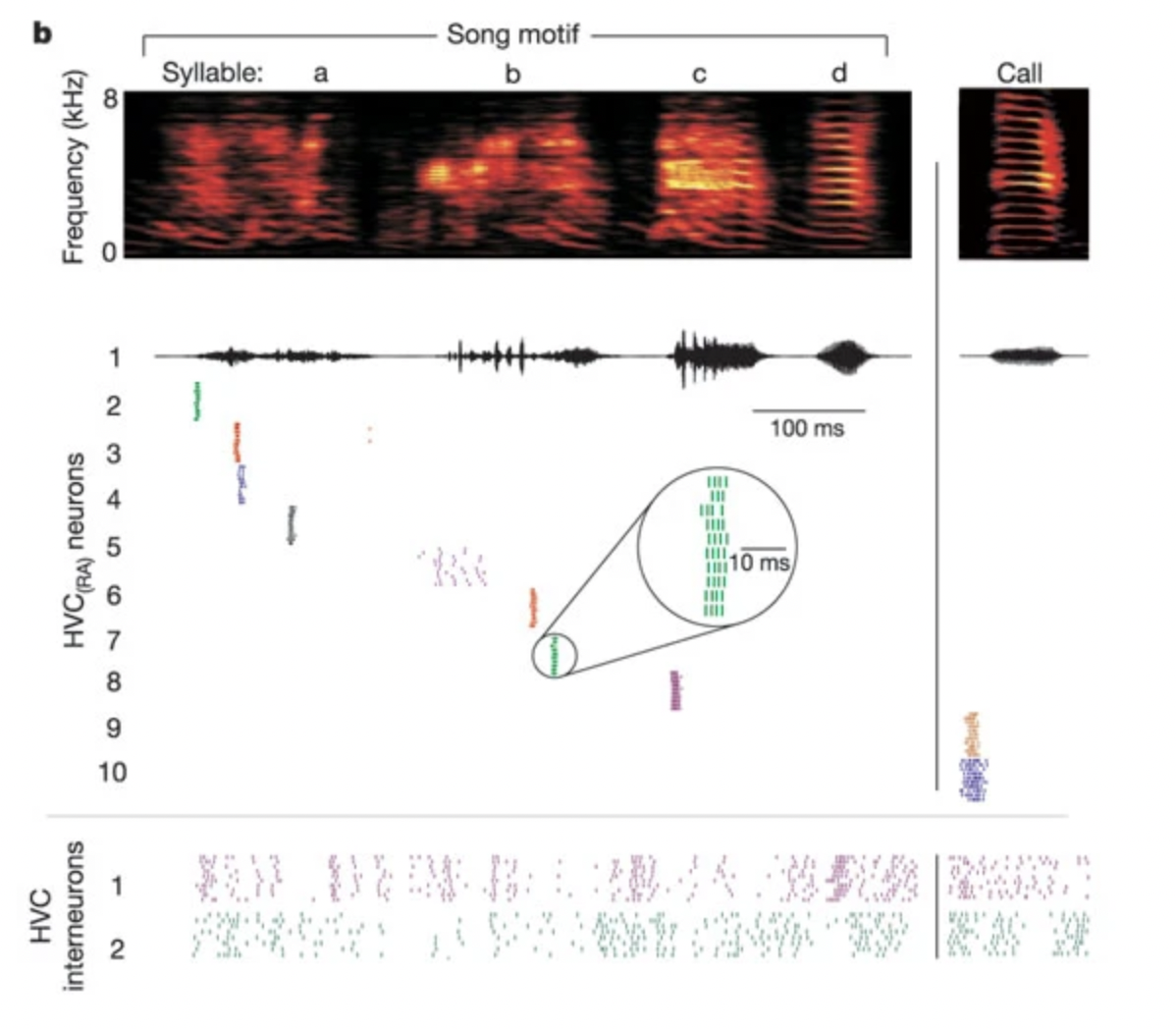
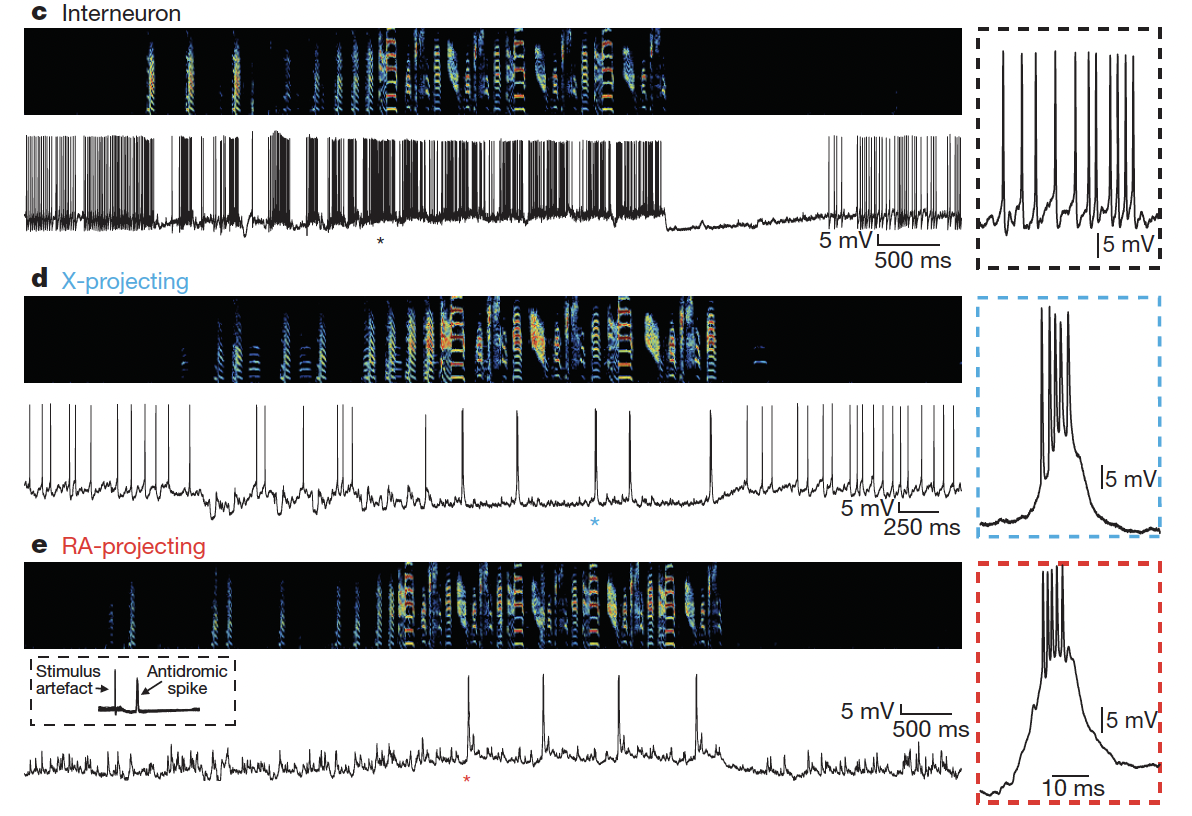
Neurons in HVC play a critical role in the song system. HVC functions as a pattern-generator coding for syllable order and the song’s overall temporal and acoustic structure (Vu, Mazurek, and Kuo 1994; Yu and Margoliash 1996; R. Mooney and Spiro 1997; Michale S. Fee, Kozhevnikov, Hahnloser 2004). There are at least three in the zebra finch HVC (Richard Mooney and Prather 2005; M. S. Fee 2004; Mooney 2000): neurons that project to the RA, neurons that project to Area X, and interneurons. The three widely known types of HVC neurons project to different areas and perform essential functions performed for vocalizations. Hahnloser 2002, for the first time, antidromically identified RA-projecting HVC neurons and showed consistent syllable encoding behavior in awake singing birds, as shown in fig 3. A set of HVC-RA neurons burst at most once during a song. As the song proceeds, a new set of HVC-RA neurons burst, forming a domino-like effect of neural activity. On the other hand, the interneuron population has a persistent background activity, also shown in fig4-bottom. The authors calculated the correlation and spike latencies of HVC-RA neurons, the interneurons, and RA neurons. They provided evidence that the comparison of spike latencies of RA and RA-projecting HVC neurons with HVC interneurons they are consistent with the measured distribution of antidromic HVC-RA spike latencies. This data, along with HVC lesion experiments, strongly suggests that RA neurons are driven in a feedforward manner by HVC neurons upstream. Since RA projects to muscles of the syrinx, a ‘muscle map’ could potentially be encoded in RA, and a ’time map’ in HVC, which helps in learning motor actions during singing.
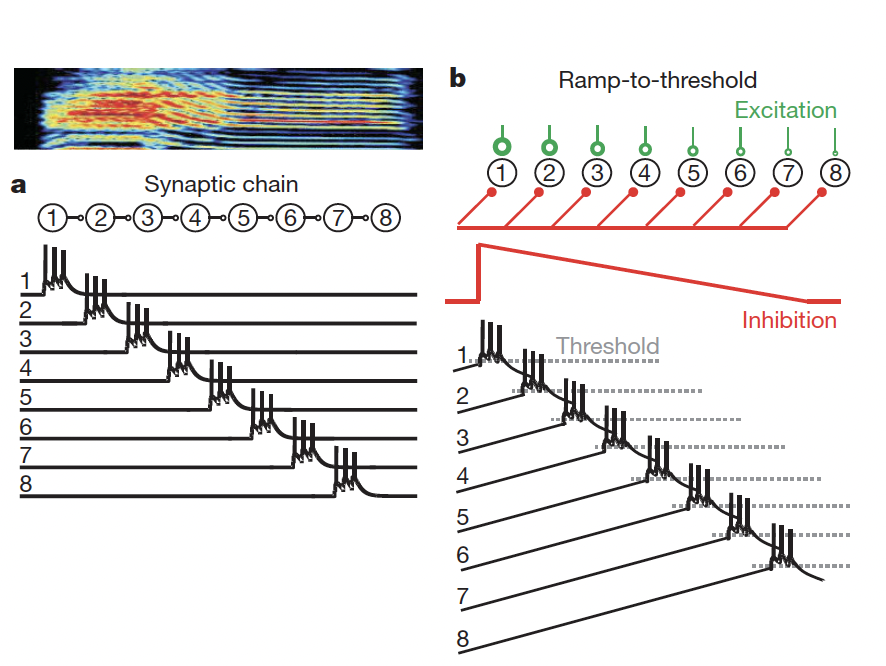
Long et al., 2010, investigated the mechanism of this sequence-generating circuit using intracellular electrical recordings. The paper provided clear evidence for a synaptic chain model instead of a ramp-to-threshold model. The synaptic chain model henceforward referred to as a ‘synfire chain’ (fig4-how a synfire chain looks), would carry neural activity in a sequential domino-like effect encoding every syllable in the song. In contrast, in a ramp-to-threshold mechanism, the same network would receive an overall slow ramping-down of an inhibitory input over time, producing a sequential activation. The authors also provide a potential mechanism in the form of a model to explain the synaptic chain model. The stereotyped sequence generation characteristic of HVC is attributed to intrinsic bursting, which was modeled as a spiking somatic compartment plus a dendritic compartment containing conductances for generating calcium spikes.
How can modeling help?
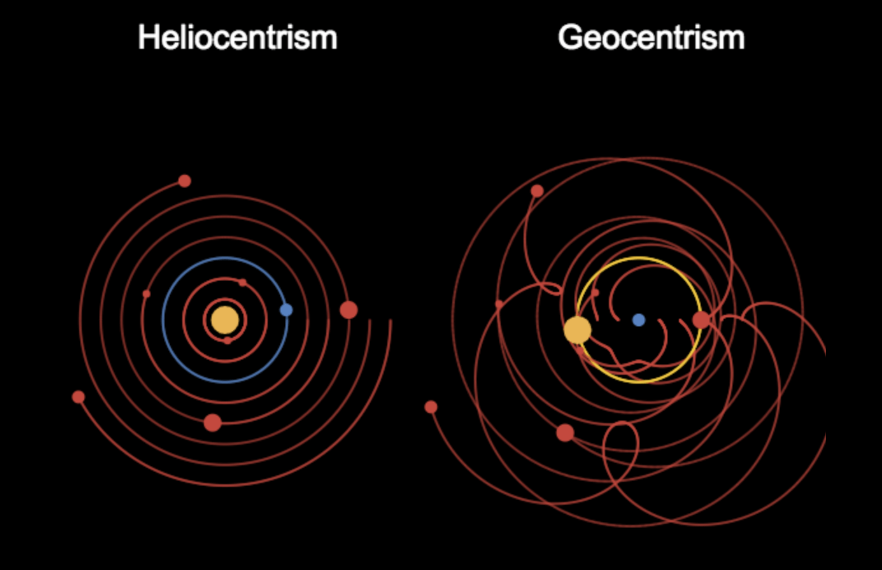
There is a historic improvement in experimental techniques, which has advanced the field of biology like never before. In a world where the accessibility to doing experiments is relatively easy, how would build a model helps us solve a biological question? The long arc of history shows us that models have been advancing our understanding of nature since the early 20th century. Just by observing the night sky with the naked eye, it was believed the Earth lies at the center of all planets, and even the Sun revolves around Earth, famously known as the geocentric model. Copernicus replaced this view, stating that it is, in fact, the Sun at the center of the solar system, also known as the heliocentric model. He formulated this theory purely based on observation about the phases of Venus, the retrograde motion of Mars and Jupiter, and differences in their apparent sizes at different times of the year. The theory was confirmed with actual data by Galileo after observing the planets through a telescope. However, this alone does not highlight the importance of a model. A conceptual model can be built around any scientific phenomenon, but more is needed to push the boundaries of research. One needs quantitive testing of the model to make realistic predictions and discover underlying mechanisms. The quantitative evidence for the heliocentric model was provided by Kepler, a set of three equations explaining the elliptical shape of orbits and the difference in the apparent speed and size of the planets.
A more recent and classic case in biology is the Hodgkin-Huxley neuron model, a central pillar of modern neuroscience. They started with the clear goal of discovering the fundamental rules governing the flow of ions in and out of a cell responsible for membrane excitability. They built this model based on carefully analyzing evidence accumulated from 150 odd studies. They started with understanding the permeability characteristics of a neuron. In addition to bringing knowledge from other disciplines to build their experimental setup, which required amplifiers and electrodes, they based these experiments on intelligent guesses made to refute the prevalent theories about membrane permeability. In order to understand the fundamentals of ion flow, they even built an experimental technique of voltage clamping, still used widely, which extensively the non-linearities of the action potential make comprehensible. The experimental data collected was compared with the mathematical predictions made from Nernst equilibrium equations.
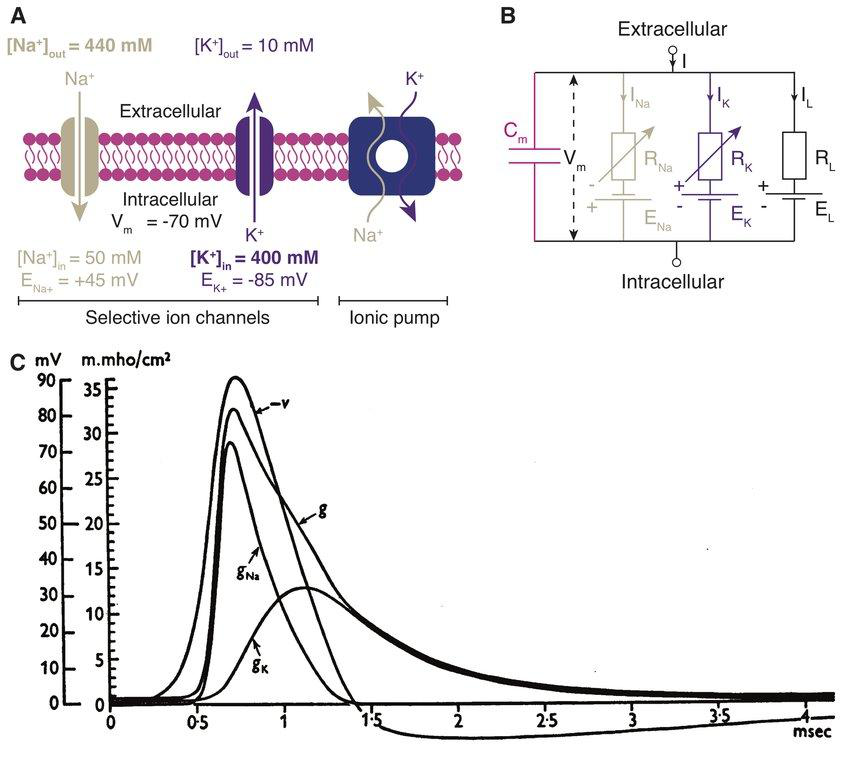
Figure 7 shows three critical points at the heart of constructing a useful model. One needs to be clear about what biological phenomenon is to be modeled. The experimental data helps form intelligent assumptions to base the model, and finally, the model should be biologically plausible and reasonably realistic. The predictions made by such a model will help us refine our hypothesis and design better experiments.
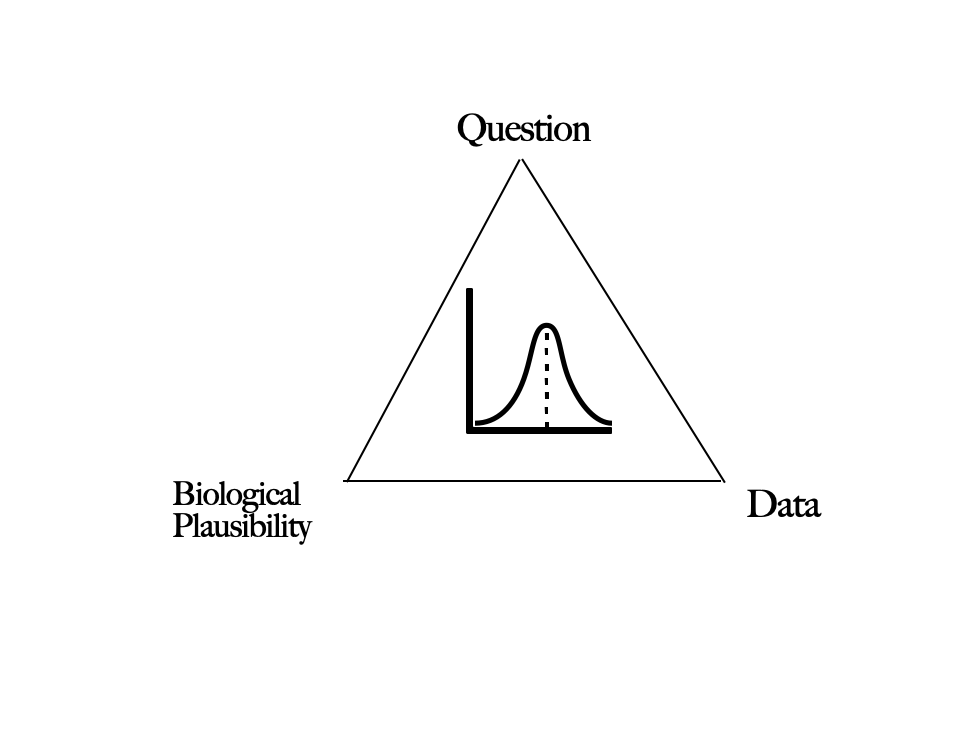
I will use these three pointers to explain each key model of the songbird motor pathway that helped advance this field. I will describe what aspect of birdsong has been modeled in light of the experimental evidence, how the model works, and explain its biological plausibility.
Problems in modeling the birdsong from a neuroscience perspective
As stated above, the production of a birdsong involves a set of dedicated brain nuclei part of the motor pathway having a learned motor program used by the bird to vocalize. It is well established that the motor program is encoded in RA. RA-projecting HVC neurons encode the song syllable and form the song sequence(Hahnloser et al.,2002). Fee et al.,2004 showed that the sparse bursts in HVC drive a set of RA neurons active at a time. According to this evidence, HVC acts as a clock signal which drives a motor pattern in RA and downstream regions up till in the syrinx muscles. (Long and Fee.,2008). Hence, RA can be considered a motor nucleus, and HVC is a pre-motor nucleus having pattern-generating characteristics. In this context, several questions are waiting to be investigated, such as:
- Sensorimotor mapping: how does the young bird learn the exact muscular or motor patterns from the tutor to produce the same song
- Song sequence: how and where is the entire song sequence encoded for long-term memory and retrival. What rules govern the transition from one syllable to another
- Pattern-generating characteristic: HVC projects to AFP (fig2) in addition to RA, which is crucial for song learning. What could be the inherent micro-circuitry and bursting mechanisms in HVC that give its pattern-generating characteristic
I have divided all the models in the field so far based on the issues mentioned above into models of a)song learning, b)song production, maintenance, and control, and c) sequence generation.
Models of song learning
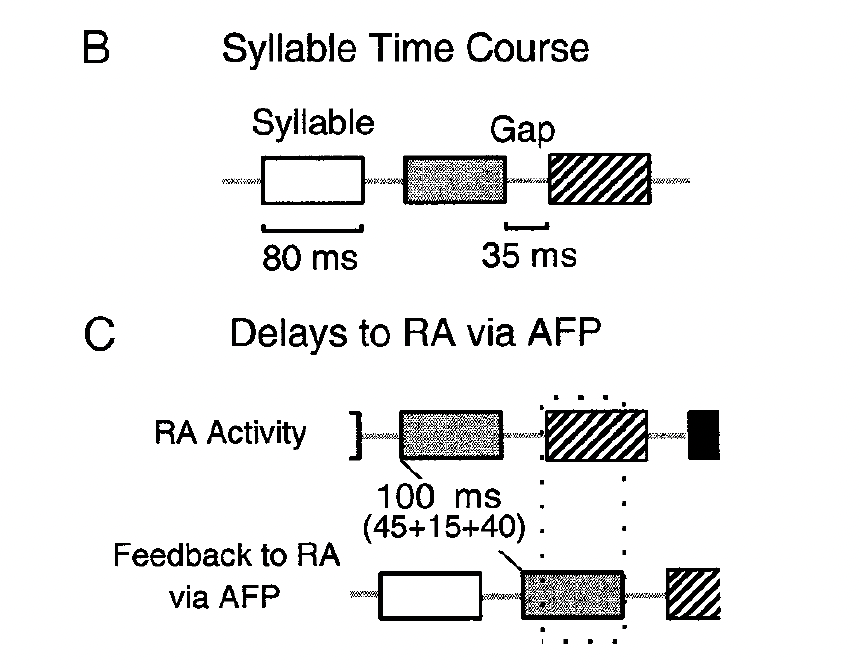
Troyer and Duope.,2000 proposed the first model of a birdsong. The goal of the model was to investigate potential mechanisms of learning the motor actions required to produce the song. The authors focused on the Zebra Finch song. While the role of HVC and RA as a part of the song system was in vivo, neural recording experiments were investigated(McCasland 1987., Yu and Margoliash 1996.,)lesions the song system to show the complete disruption of the song (Bottjer et al. 1984; Scharff and Nottebohm 1991) suggested the Anterior Forebrain Pathway (AFP) (Fig2) does play a crucial role in song learning but is not involved in song production as such, which led to the emergence of the ‘AFP comparison hypothesis,’ which states that AFP guides sensorimotor learning by transmitting a comparison signal between auditory feedback from the bird’s own song and memorized template. These signals are then used to guide learning at the level of RA. (Bottjer and Arnold 1986; Doupe 1993; Mooney 1992). However, this hypothesis has a fundamental caveat: the feedback delay problem. In a Zebra finch song, there arises a latency of about 100ms for the AFP comparison signal to arrive in the motor pathway after a motor command is given(see fig8). This delay is as long as a sing syllable which could cause the comparison signal to overlap with the neural activity of the following syllable. To combat this fundamental issue, Troyer and Doupe.,2000a suggest the role of an ’efference copy.’ An efference copy signal is an internal prediction generated in HVC, which would be used to compare with the song template stored in AFP, which would guide motor learning in RA, as AFP has direct connections to RA. It was a simple model based on only Hebbian learning rules (associational learning rules).
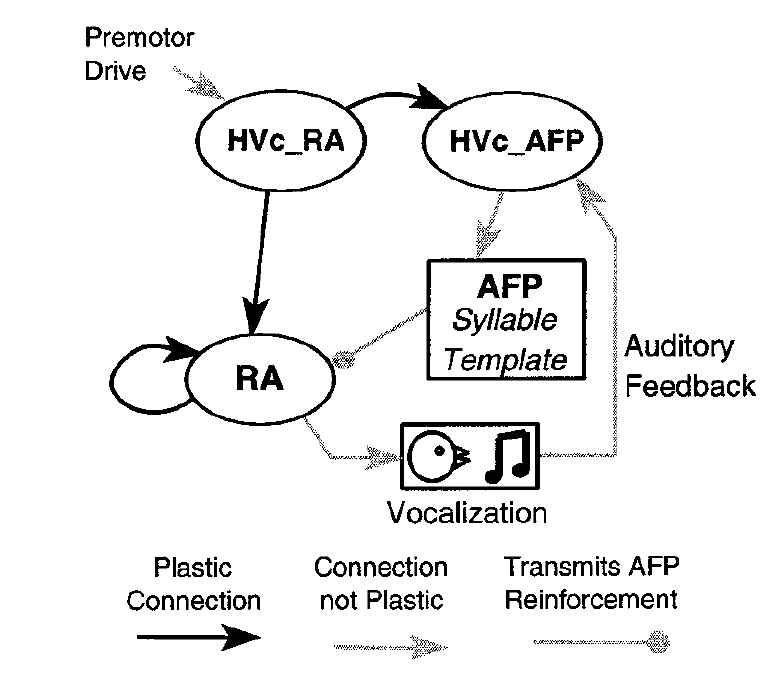
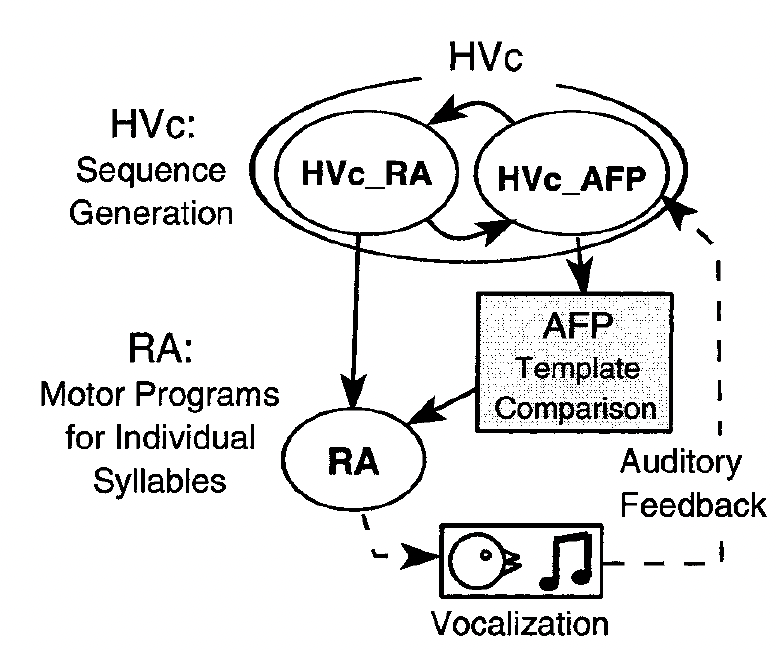
The network predicts that AFP is responsible for template comparison and a site for template storage. The model is built by assuming two interconnected but separate populations of neurons projecting to RA and AFP. One is used during song learning, and the other during efference copy learning and transmission, respectively. The model explains the role of AFP guided by template comparison in sensorimotor learning or learning of the birdsong syllables in Zebra Finch. In Troyer and Doupe 2000b, this model is extended to investigate how song sequences are generated. The authors propose that for song sequences to be generated, there must be a reciprocal connection between RA-projecting and AFP-projecting HVC neurons. The efference copy, a motor->sensory mapping between HVC-RA and HVC-AFP neurons, contributes to only half of the process; the other half comes from the interaction of HVC-AFP to HVC-RA neurons. Thus the model posits a new link between AFP and HVC, transmitting what they call a ‘context signal.’ Sequences are defined as a consecutive chain of mappings from motor->sensory->next motor->next sensory and so forth. Without these context signals, the information of the previous syllable would not influence the occurrence of the following syllable, and the HVC pattern would be completely random. The authors also have an additional patterned connection between AFP and HVC; without this connection, AFP would not be able to guide learning in the motor pathway. The network architecture is shown in fig10
Drew and Abbott.,2003 proposed the first conductance-based model, which addressed syllable learning of the birdsong (see fig 11). The model was a pure feedforward network mimicking neurons in the field L of the bird brain, which is analogous to the primary auditory cortex of the mammalian brain, whose output became an input to the second stage of the functional network, which is modeled to be selective for syllables or a combination of syllables of the birdsong. Data from Lewicki and Arthur.,1996, Margoliash and Fortune 1994 suggest the song/syllable selective neurons are located in HVC. The field L stage was modeled as a set of firing rates generated by spectro-temporal receptive filters(STRF). An STRF is a mathematical function, when applied to a neuron’s response, tells us if that particular neuron gets excited or inhibited by a particular frequency. The HVC stage was modeled as spiking neurons which realistic synaptic conductances, following the Hodgkin-Huxley equations. This model’s unique feature is that it uses two excitatory subnetworks that are selective for two different syllables and have recurrent excitatory connections that amplify their responses. When a generic clocked timing signal replaced the syllable-selective drive to this network, the network could generate responses selective for a particular signal and also generate them. This suggests that temporal selectivity has a particular sequence of syllables encoded into the circuitry, which might be capable of generating motor patterns in addition to sensory patterns.
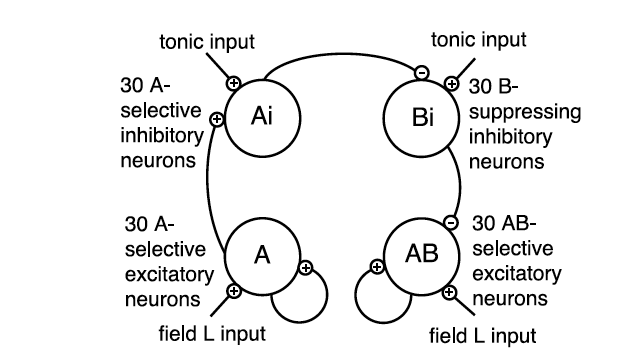
A conductance-based model can be computationally heavy to simulate. Another way to understand the flow of information would be to use point neurons or artificial neurons to simulate massive artificial neural networks. Fiete et al.,2004 built a purely feedforward artificial neural network with gradient learning rules to investigate premotor representations. The model demonstrates how ultra-sparse neural activity helps to learn premotor representations and how the learning rate depends on the number of times a particular HVC neuron is active during a song motif.
Models of song production, maintenance, and control
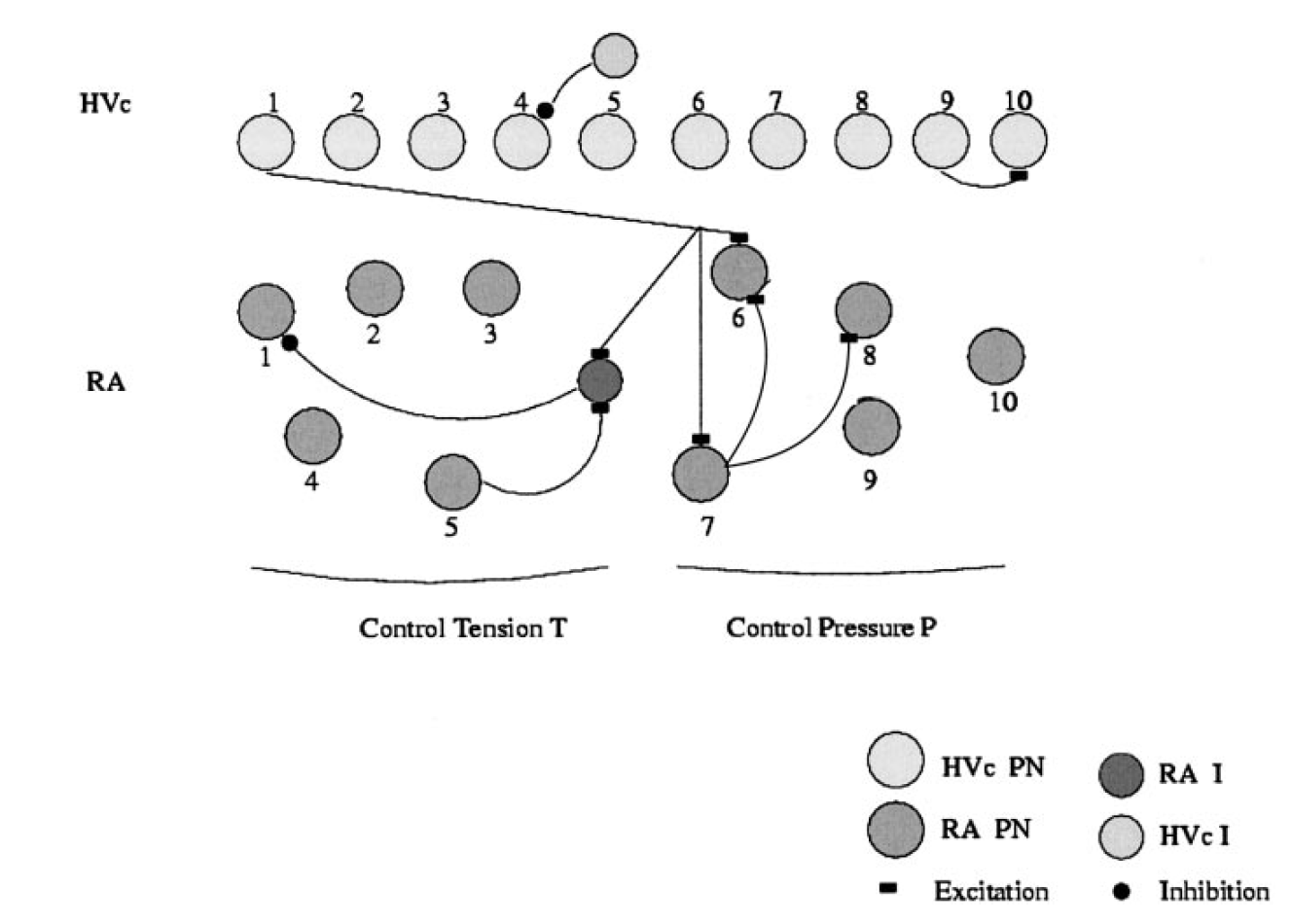
While learning about the birdsong is essential from a neuroethological perspective, understanding how exactly the birdsong is produced, maintained, and controlled will give us more insights into the working of the avian brain. Abarbanel et al.,2004 built a simple spiking neural network model using Hodgkin-Huxley-type neurons to map the acoustic features of the birdsong into its neural architectures to model the underlying mechanisms. Previous work by Laje and Mindlin 2002, tried to bridge this gap by using the rate model; however, that model failed to capture the more recent findings that the activity of RA neurons is typically driven by HVC’s sparse bursting neurons (Hahnloser et al.,2002). This is why this model focuses on modeling RA activity under a forcing function such that half of RA neurons control the tension in syrinx muscles that determines the frequency of vocalizations of the birdsong (Goller and Suthers 1996; Laje and Mindlin 2002) and the other half control the respiratory pressure, in addition, has interneurons connectivity inside of RA. During the non-singing state, RA has ~15Hz of spontaneous spiking activity (Mooney 1992; Spiro et al.,1999 ee Yu and Margoliash 1983.,), which is significantly different from the high-frequency bursting produced during singing (Hahnloser et al.,2002 and Yu and Margoliash 1996). The inhibitory interneurons in RA, in this particular model, suppress this spontaneous activity during singing. RA neurons spike only when the direct excitatory drive from HVC is stronger than the global inhibition. This model posits that in addition to studying how HVC→RA connectivity is modified by learning or synaptic plasticity under the influence of AFP, it would be crucial to look at the internal connectivity of RA and the role of inhibition.
Role of other input brain nuclei to the song system
In addition to the regions depicted in Fig1, two more critical brain nuclei influence vocal processing, learning, and sequence generation—NIf () is a cortical region that projects to higher cortical areas and HVC. NIf is an association cortical area processing auditory and motor information. It is the largest and most significant link providing an excitatory drive from the cortex to HVC. NIf is also known to have premotor burst patterns that precede HVC burst patterns (McCasland, 1987; Lewandowski and Schmidt, 2011) and drives the song replay during sleep (Hahnloser and Fee, 2007). Uva (), a thalamic nucleus has recurrent connections to HVC, as shown in Fig . Stimulation of this brainstem component disrupts song timing (Ashmore et al.,2005), and Uva lesions permanently disrupt the song (Coleman and Vu 2005; Williams and Vicario 1993). It is essential to know these key regions fairly well, studying experimentally before understanding models of song sequence generation.
Models of sequence generation
The song repertoire of zebra finch offers us an opportunity to ask many questions to understand avian information processing. However, turning to other songbird species allows us to still answer fundamental questions about avian information processing. Bengalese finch (Lonchura striata var. domestica) song syntax is described by finite state automation have a stochastic transition between syllables and notes (Okanoya, 2004a), as opposed to zebra finch, sing, which is highly stereotyped and the same across all bouts. A repetitive collection of syllables are called chunks for a Bengalese Finch song. While studying the sequence of chunks, a particular chunk’s occurrence depends not only on the previous chunk but also on the last few chunks. Such a process is called a higher-order Markov process. By definition, an n-th order Markov process is a process whose next state depends on the previous n states. Katahira et al.,2007 (Fig 12) was the first paper to build a spike-based neural network that works as a higher-order Markov process expanding it into a first-order Markov process of a Bengalese Finch song. The importance of this work lies in the fact that, at this point, the neural mechanisms underlying the stochasticity of the Bengalese Finch song were investigated only during electrophysiology or lesion studies. (for a review, see Okanoya 2004b). The experimental knowledge at the time from Mooney and Prather 2005, significantly helped build this model. The model introduced a lateral inhibition mechanism in HVC that ensued a stochasticity transition as a first-order Markov process. This model did not provide conclusive evidence that Bengalese finches follow this mechanism but the mechanisms proposed are experimentally verifiable. Hoshino and Okanoya 2000., showed that NIf, an upstream area to HVC, leads to a significant decrease in stochastic branching points when disrupted. This suggests that NIf could be a source of stochasticity.
While the paper builds upon what creates stochasticity in song sequence generation, it only tells us a little about how the transition from one syllable to the next syllable takes place. What underlying probabilistic mechanics create the sequential neural activity that gives rise to the song sequence? Jin, in 2009 suggested that the syllable encoding neurons are integrated into a branching chain network. There are branching points where the branching decides which branch is to be selected. The selection is probabilistic and uses the winner-takes-all mechanism mediated by inhibition. This transition is markovian. This model explains the songbird motor pathway’s unique but stereotyped pattern generation property potential mechanisms responsible for the sparse bursting pattern of HVC.
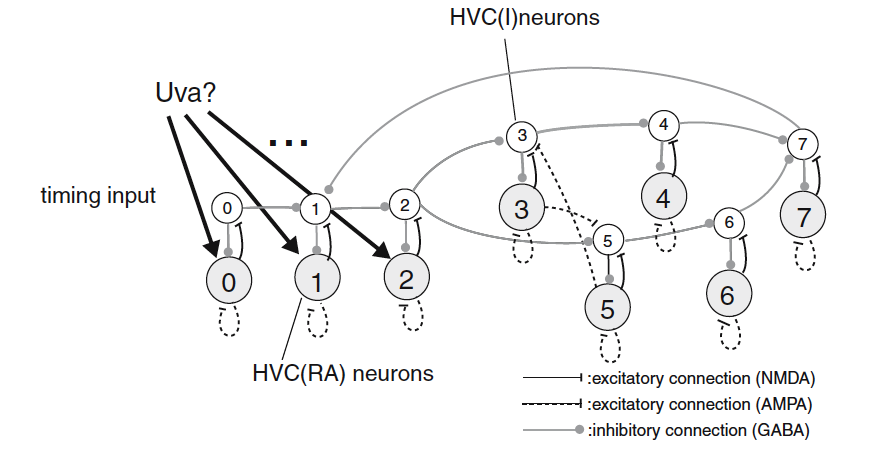
While the models so far have been focused on the motor pathway shown in Fig1, Gibb and colleagues 2009 published two models introducing the role of the brainstem feedback loop. Uva plays a critical role in building this fairly realistic mode. The first model proposed by Gibb et al.,2009a is built on the idea that RA-projecting HVC neurons operate in bistable units generating sparse HVC activity. The connectivity of their micro-circuitry is heavily dependent on the data from Mooney and Prather.,2005 especially their observations that are depolarizing HVC_RA→HVC_RA and HVC_RA→HVC_interneurons and hyperpolarising HVC_interneurons→HVC_RA connections. The recurrent excitatory feedback of HVC_RA gives rise to its bistability characteristic. The HVC_RA cluster has two stable states: quiescent and persistently spiking, modeled as fixed points and stable limit cycles, respectively. The model’s uniqueness lies in providing and arguing with evidence about the inhibition mechanism within HVC interneurons. It is already known that HVC_interneurons neurons spike and have a sustained background during pattern throughout the song; given this sustained activity, how do these interneurons contribute to shaping the excitatory projections neurons’ sparse bursting activity? There could be two mechanisms: first, the ‘inhibitory buildup’ mechanism, which posits that relatively weak feedback inhibition of the projection neurons by the interneurons could exert a hyperpolarizing influence throughout the burst leading to a significant decrease in the spiking frequency, followed by a failure in spiking and termination of the burst. The second mechanism, known as the ‘inhibitory pause’ mechanism, posits that a burst in projection neurons could occur when there is a pause in the activity of interneurons and a strong onset of inhibition after a few milliseconds terminate the burst sequence. The authors of Gibb et al.,2009a argue in favor of the inhibitory pause mechanism; in other words, small changes in the strength and timescale of inhibition are inconsequential; what matters is the delay between the onset of the burst and the onset of inhibition. (see fig 13)
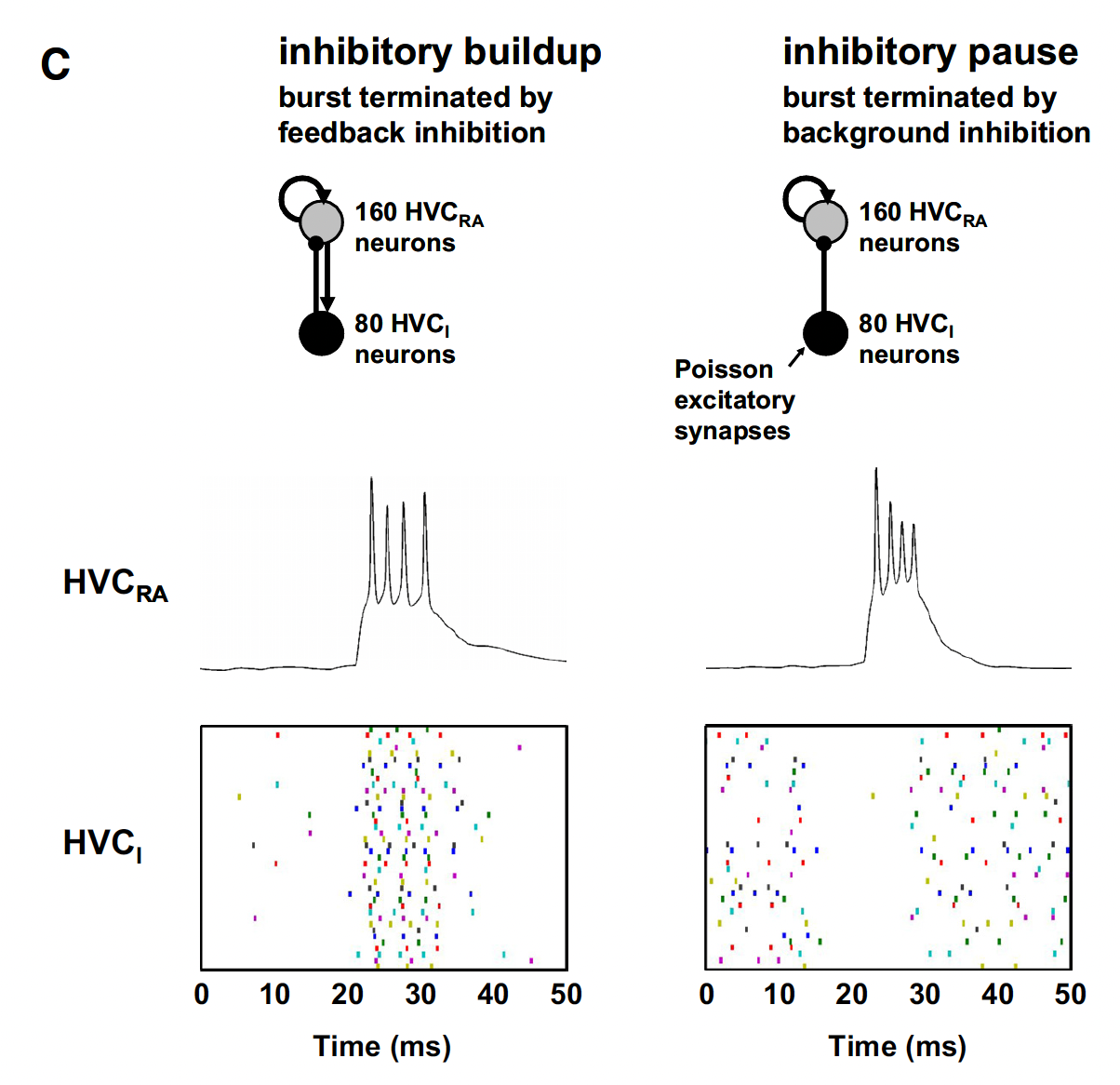
A second problem encountered while considering inhibition in neural circuits is wheater there is local or global inhibition. In the present study, the model is based on the inhibitory pause mechanism based on global inhibition where each HVC_interneuron is connected to a set of HVC_RA neurons as opposed to each HVC_interneuron connecting to some of HVC_RA neurons only in some part of the HVC_RA cluster. This model successfully validates the experimental data by Hahnloser et al.,2002, Kozhevnikov and Fee.,2007, and Fee et al.,2004 about sparse HVC bursting and driving RA neurons to burst in a sequence. The model also predicts that if GABA synapses are blocked, HVC projection neurons will enter a state of persistent activity and a potential role of CA+ currents in HVC_RA bursting.
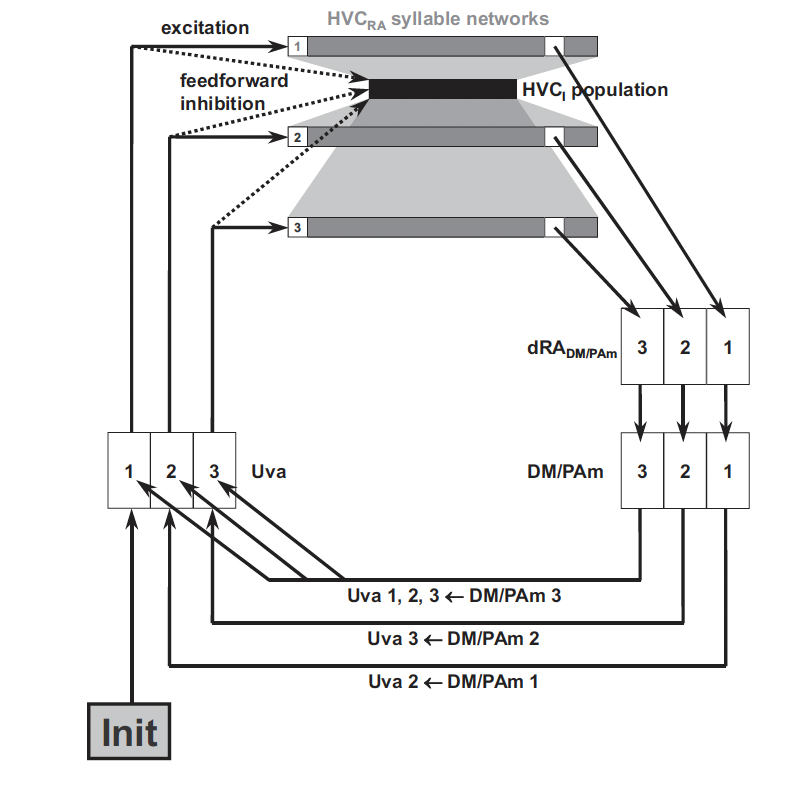
The extended model incorporates HVC and other brain nuclei of song system. There is experimental evidence that there are no bilateral connections between the two HVCs. The authors make an assumption that the two HVCs, through some mechanism, remain coordinated during song sequences; for this coordination to remain smooth, there should be some signal that not only synchronizes the two HVCs but also encodes the identity of the following syllable. This is referred to as syllable-specific input. Uva is a involved in specifying the timing and identity of syllables in the left and right HVC. Hence, the present model includes HVC→dRA→brain stem→Uva→HVC feedback loop, the key being the feedback pathway via Uva sequentially activating the networks controlling syllable sequence generation. HVC, dRA, dorsomedial nucleus of the intercollicular complex/nucleus paraambigualis (DM/PAm), and Uva are all assumed to contain syllable-specific neuron clusters. The model is built with Hogdkin-Huxley neurons. It proposes that each syllable is encoded by a set of a chain of HVC neurons dedicated only to that syllable. During the song, a syllable-specific input is sent from one chain to the next via the feedback pathway through dRA, brainstem, and Uva. Hence, the song is stored in the feedback pathway connections itself. Like the companion paper, HVC interneurons are responsible for the termination of the bursts. Syllable-controlling parts of HVCRA networks project more strongly to RAm- and nXIIts-projecting regions of RA (dRARAm and vRAnXIIts), whereas gap-controlling parts of HVCRA networks project less strongly. The arrival of input from Uva truncates the activity of the gap-controlling part. Each neuron in dRA-RAm and vRA-nXIIts is twice as likely to receive a synapse from a syllable-controlling HVC-RA neuron as from a gap-controlling one. This model thus highlights the role of the brainstem and Uva and suggests the existence of a syllable-specific population responsible for song sequence generation.
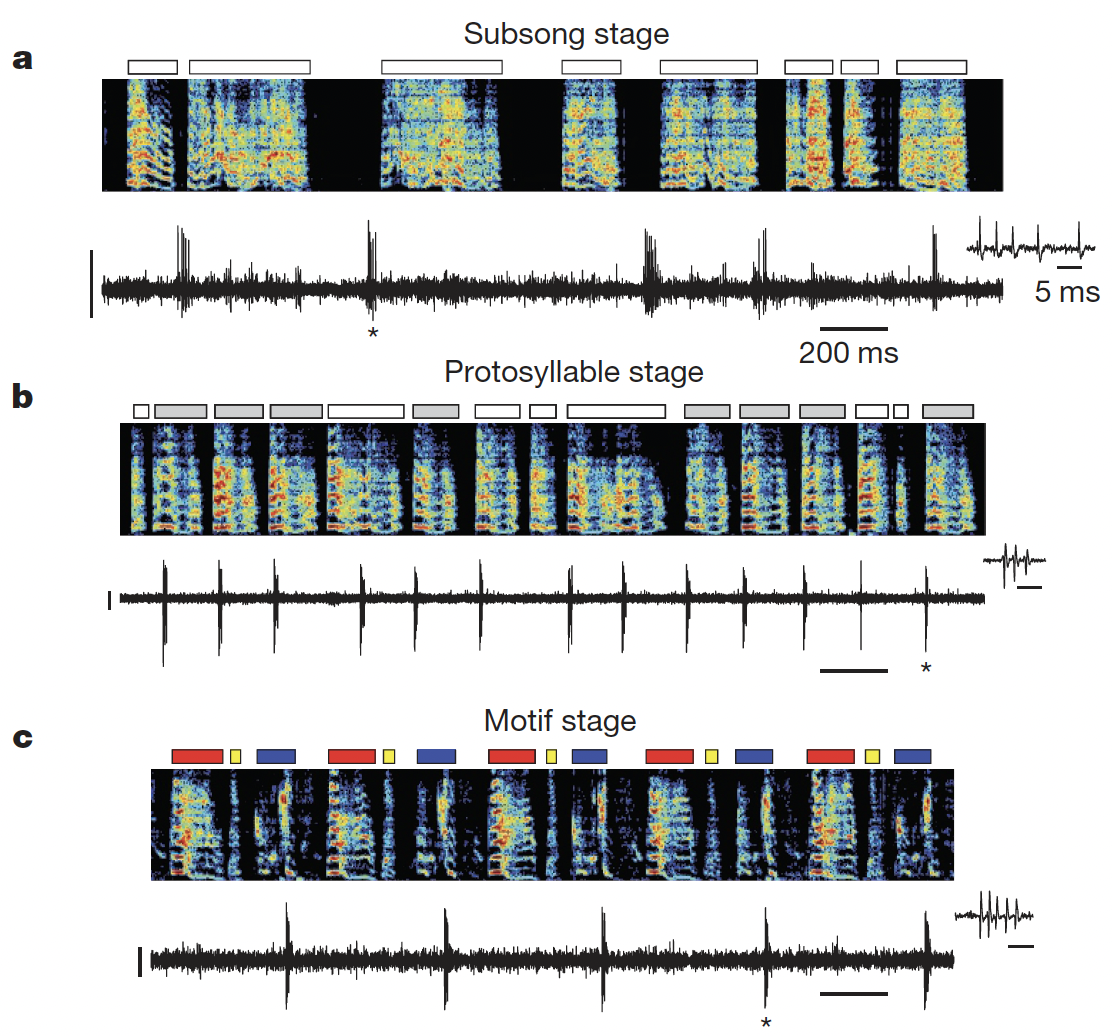
Okubo et al.,2005 investigated the construction of vocal sequences during vocal development. The authors here describe the song development phase in three parts, namely: the subsong phase (-50 says post-hatch:dph), where the juvenile bird starts babbling; the protosyllable phase (56-59 dph), as the same suggestions, protosyllable structures are formed and the motif stage (62–72) where the song gets fully formed—the spectrograms for the three stages in fig. Neural activity for HVC projection neurons in juvenile birds showed that the neurons were time locked with syllable onset, this effect increasing from the subsong stage to the motif stage. At the subsong stage, only half of the neurons were time locked, with the number gradually increasing through song development. The hypothesis that new syllables emerge by splitting protosyllable was tested and validated. The neural sequences corresponding to a new syllable would largely overlap with neurons shared across the emerging syllables. Thus spittling would involve an increase in the number of neurons encoding a new syllable and a decrease in the shared neurons. This was experimentally confirmed with neural recording data. A mechanistic model was built with binary units representing HVC projection neurons based on this evidence and the idea that all new syllables are born from a primitive protosyllable. The model uses a combination of spike-timing-dependant-plasticity and heterosynaptic competition, which transform the randomly connected network (representing a subsong) into a feedforward synaptically connected network with sequential sparse bursting activity. The network is modeled in such a way that a small set of HVC neurons gets an external input; this subset acts an as a seed set from which elaborate chains of new syllables emerge in later stages of learning. This model provides a novel mechanism for song sequence formation, which helps the prototype motor programs to be reused by the daughter motor program. Vocalization requires precise coordination between singing and breathing. Thus such a protosequence in HVC would allow the bird to learn appropriate coordination between respiration and the muscle system.
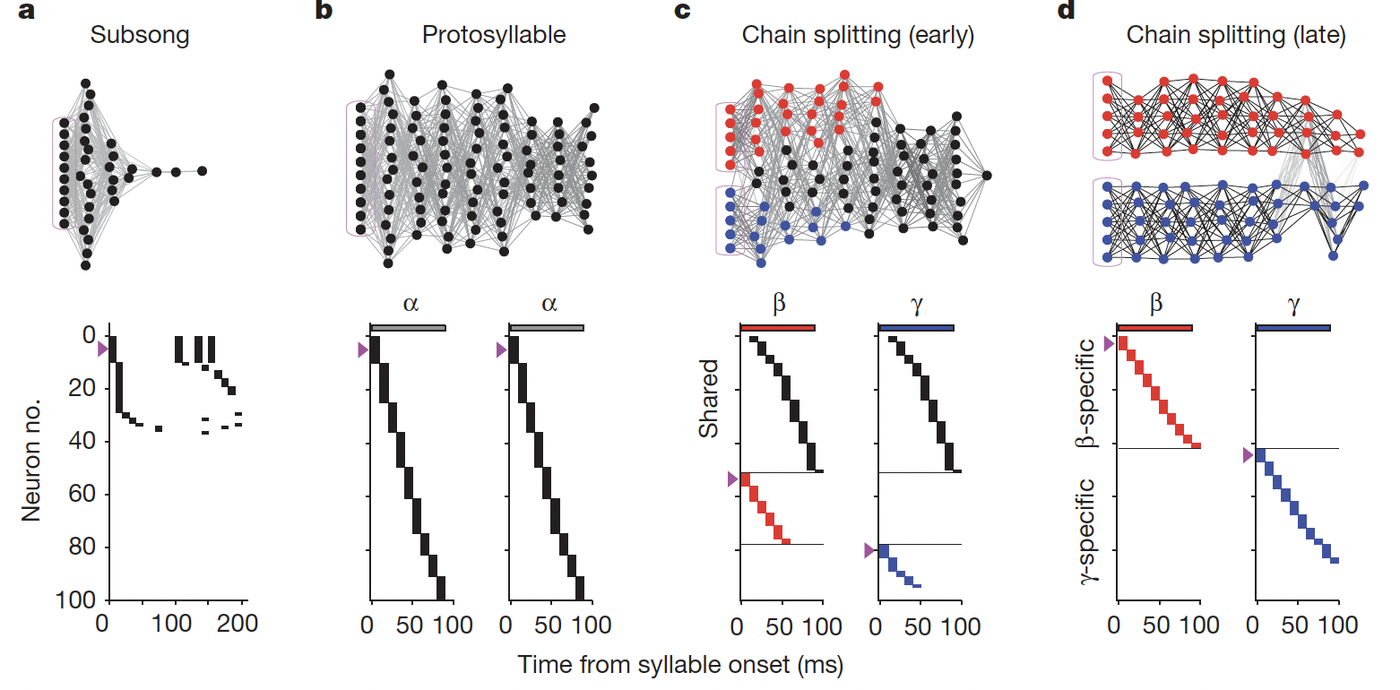
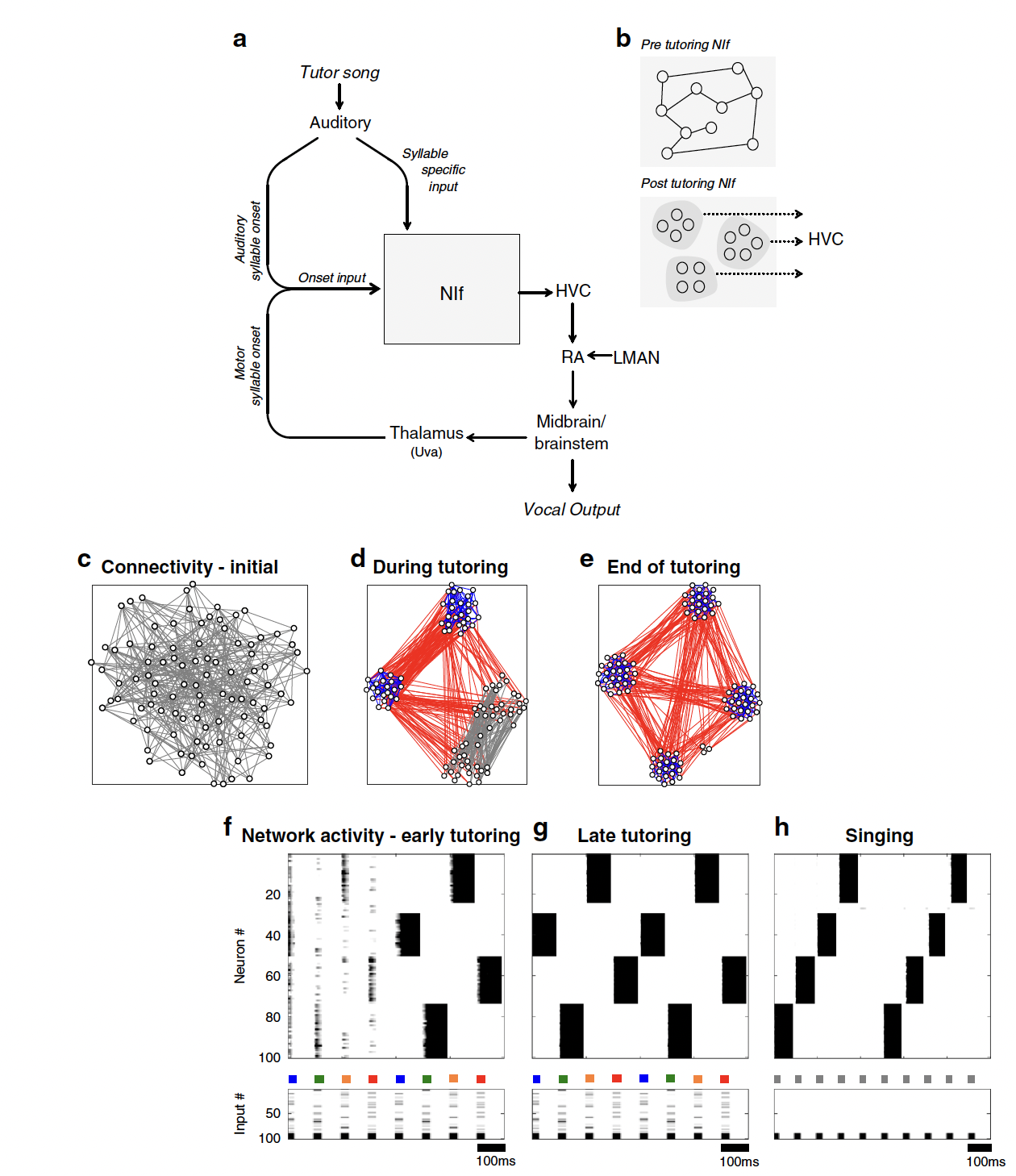
While the role of Uva has been investigated, the role of NIf has yet to be incorporated into any model. Okuba et al. 2015., clearly shows the premotor sequence generation characteristic of HVC-projecting NIf neurons. Machevicius et al.,2020 propose a model for sequence generation suggesting an auditory cortex might play a critical role. The model uses the idea from Okuba et al.,2015, the new sequences emerge from protosyllables through song development. The mechanism posits that protosyllables emerge from syllable onsets, which split into daughter sequences that slowly crystalize through vocal development. In the execution of the model, HVC receives brief bursts of external input that drives a set of seed neurons (representing subsong) which rearrange into a protosequence and then split into the daughter sequence. In the process, the HVC gets organized into a network having a sequential sparse bursting activity. Based on a large body of experiments, the authors hypothesize that the external input received by HVC is mainly from the auditory cortex. NIf( Nucleus Interface), a higher-order sensorimotor cortical area that projects to HVC, plays a role in song learning. NIf is analogous to the mammalian association cortex, a network of auditory and motor cortical areas. What NIf is to the avian brain, Spt is to the human brain, a human speech processing area located at the intersection of auditory and motor functions in which the neural activity is also locked to the onset of words and phrases. Similarly, HVC-projecting NIf neurons are time-locked with syllable onsets. To test the hypothesis that NIf does provide external input to the seed neurons of HVC, electrical activity from NIf neurons was recorded in awake juvenile birds while singing and listening to the tutor’s song. The data suggests NIf neurons are indeed time-locked to syllable onsets and have syllable-specific activity; they fire at the onset of some neurons but not for others.
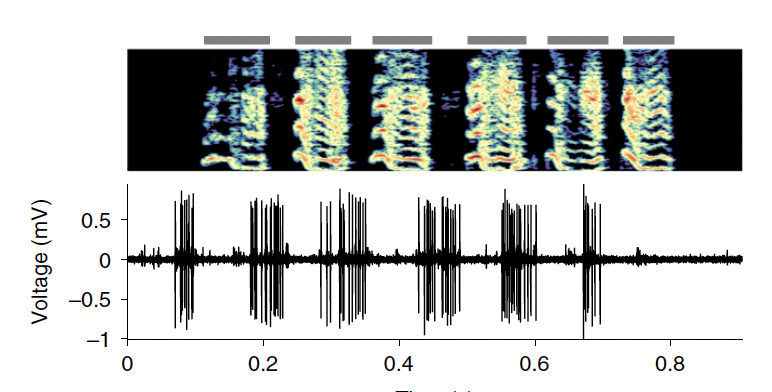
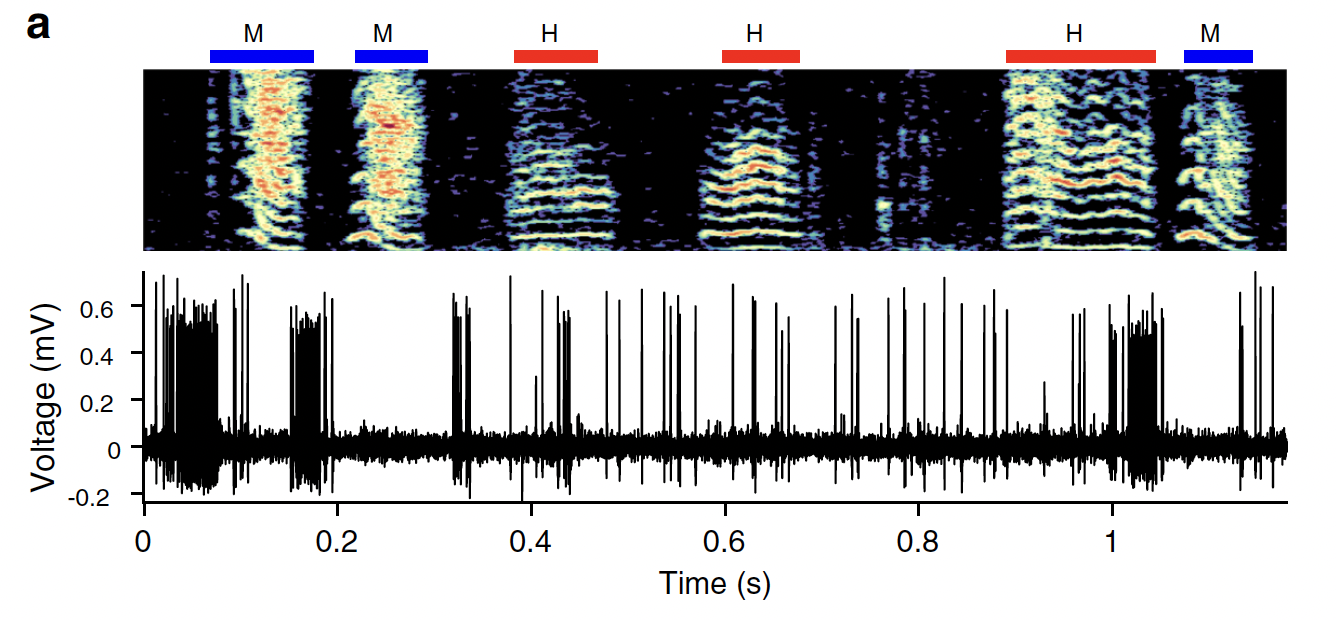
The time-locked property of NIf neurons suggests that NIf chunks the song into constituent syllables not only while singing but also while listening. Thus, NIf may play a role in aligning auditory and motor representations of a song during song learning. Based on this evidence, the authors built a NIf model, such that the NIf network encoded a distinct set of a neural ensemble for each syllable of the song being learnt and later uses those ensembles to sing the song. The syllable-specific ensembles are reactivated as attractors of NIf driven by syllable onset signal. To test the crucial idea that NIf provides external input to HVC, this NIf network was combined with the HVC network from Oksbu.,2015 paper. This combined NIf/HVC model proposes a mechanism where HVC learns sequence durations by the period activity imposed by NIF. Zhao et al. provided experimental evidence for the same. This model helps us understand how input from the sensory system could build a motor program and a precise mapping between sensory and motor representations.
Collective insights
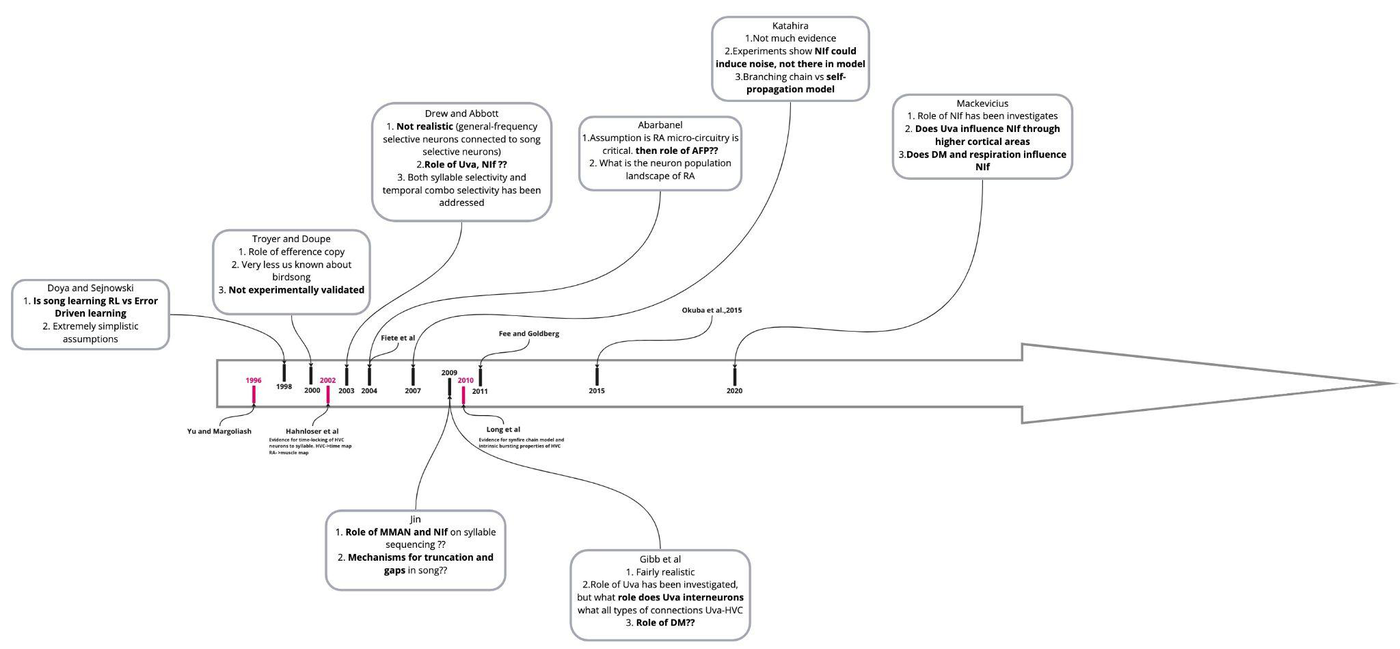
The figure above shows the trajectory of how modeling studies evolved and helped us understand more about vocal learning and ask better questions waiting to be investigated with state-of-the-art experimentation. The pink time points represent key experimental papers; the bold text represents the shortcomings of that particular model. I can pose some questions about these shortcomings that could be tested with a slightly better model.
Open questions in the field
1. Is song learning reinforcement learning (RL)-driven learning or error-driven learning (EDL)
Both RL and EDL are mechanisms for learning sensory-to-motor information. In EDL, an error signal is generated by comparing the feedback from bird’s own song, and the stored template drives the motor learning. EDL requires feature-to-feature mapping. In RL, the development and variability of the song generate a host of vocalizations and template comparison signals which is non-specifically sent to motor pathways, where the best match is reinforced. There is evidence for both types of learning, but there is no consensus. Modeling the songbird pathway in more detail would help investigate this question
2. Neuron population landscape from Uva to HVC, and how would that affect the song sequence
What kind of neuron population is present in Uva, what is the excitation-inhibition balance, and is the firing activity pattern time-locked with some part of the motif? Investigated Uva similar to how NIf has been would be an interesting direction to pursue
3. Is there a source for pattern generation in HVC upstream, or is it an emergent property of its connectivity
Discovering the source of pattern generation property would require modeling the synaptic connectivity details. We know NIf, which is upstream of HVC has a premotor sequence time-locked with syllable onsets, what causes that pattern generation, and how is the neural information transformed from higher auditory cortices to NIf and HVC.
References
- Abarbanel, Henry D. I., Leif Gibb, Gabriel B. Mindlin, and Sachin Talathi. 2004. “Mapping Neural Architectures onto Acoustic Features of Birdsong.” Journal of Neurophysiology 92 (1): 96–110. https://doi.org/10.1152/jn.01146.2003.
- Bottjer, S. W., E. A. Miesner, and A. P. Arnold. 1984. “Forebrain Lesions Disrupt Development but Not Maintenance of Song in Passerine Birds.” Science (New York, N.Y.) 224 (4651): 901–3. https://doi.org/10.1126/science.6719123.
- ———. 1986. “Changes in Neuronal Number, Density and Size Account for Increases in Volume of Song-Control Nuclei during Song Development in Zebra Finches.” Neuroscience Letters 67 (3): 263–68. https://doi.org/10.1016/0304-3940(86)90319-8.
- “Brainstem and Forebrain Contributions to the Generation of Learned Motor Behaviors for Song | Journal of Neuroscience.” n.d. Accessed January 4, 2023. https://www.jneurosci.org/content/25/37/8543.
- Doupe, A. J. 1993. “A Neural Circuit Specialized for Vocal Learning.” Current Opinion in Neurobiology 3 (1): 104–11. https://doi.org/10.1016/0959-4388(93)90043-x.
- Doya, Kenji, and Terrence J. Sejnowski. 1998. “A Computational Model of Birdsong Learning by Auditory Experience and Auditory Feedback.” In Central Auditory Processing and Neural Modeling, edited by Paul W. F. Poon and John F. Brugge, 77–88. Boston, MA: Springer US. https://doi.org/10.1007/978-1-4615-5351-9_8.
- Drew, Patrick J., and L. F. Abbott. 2003. “Model of Song Selectivity and Sequence Generation in Area HVc of the Songbird.” Journal of Neurophysiology 89 (5): 2697–2706. https://doi.org/10.1152/jn.00801.2002.
- Durand, S. E., J. T. Heaton, S. K. Amateau, and S. E. Brauth. 1997. “Vocal Control Pathways through the Anterior Forebrain of a Parrot (Melopsittacus Undulatus).” The Journal of Comparative Neurology 377 (2): 179–206. https://doi.org/10.1002/(sici)1096-9861(19970113)377:2<179::aid-cne3>3.0.co;2-0.
- “Dynamics of the Vocal Imitation Process: How a Zebra Finch Learns Its Song | Science.” n.d. Accessed January 3, 2023. https://www.science.org/doi/10.1126/science.1058522.
- Fee, Michale S., Alexay A. Kozhevnikov, and Richard H. R. Hahnloser. 2004. “Neural Mechanisms of Vocal Sequence Generation in the Songbird.” Annals of the New York Academy of Sciences 1016 (June): 153–70. https://doi.org/10.1196/annals.1298.022.
- Gahr, M. 2000. “Neural Song Control System of Hummingbirds: Comparison to Swifts, Vocal Learning (Songbirds) and Nonlearning (Suboscines) Passerines, and Vocal Learning (Budgerigars) and Nonlearning (Dove, Owl, Gull, Quail, Chicken) Nonpasserines.” The Journal of Comparative Neurology 426 (2): 182–96.
- Goller, F., and R. A. Suthers. 1996. “Role of Syringeal Muscles in Controlling the Phonology of Bird Song.” Journal of Neurophysiology 76 (1): 287–300. https://doi.org/10.1152/jn.1996.76.1.287.
- Hahnloser, Richard H. R., and Michale S. Fee. 2007. “Sleep-Related Spike Bursts in HVC Are Driven by the Nucleus Interface of the Nidopallium.” Journal of Neurophysiology 97 (1): 423–35. https://doi.org/10.1152/jn.00547.2006.
- Hamaguchi, Kosuke, Masashi Tanaka, and Richard Mooney. 2016. “A Distributed Recurrent Network Contributes to Temporally Precise Vocalizations.” Neuron 91 (3): 680–93. https://doi.org/10.1016/j.neuron.2016.06.019.
- Jarvis, E. D. 2004. “Learned Birdsong and the Neurobiology of Human Language.” Behavioral Neurobiology of Birdsong. https://doi.org/null.
- Katahira, Kentaro, Kazuo Okanoya, and Masato Okada. 2007. “A Neural Network Model for Generating Complex Birdsong Syntax.” Biological Cybernetics 97 (5): 441–48. https://doi.org/10.1007/s00422-007-0184-y.
- Kubota, Michinori, and Ikuo Taniguchi. 1998. “Electrophysiological Characteristics of Classes of Neuron in the HVc of the Zebra Finch.” Journal of Neurophysiology 80 (2): 914–23. https://doi.org/10.1152/jn.1998.80.2.914.
- Lewandowski, Brian C., and Marc Schmidt. 2011. “Short Bouts of Vocalization Induce Long-Lasting Fast γ Oscillations in a Sensorimotor Nucleus.” The Journal of Neuroscience: The Official Journal of the Society for Neuroscience 31 (39): 13936–48. https://doi.org/10.1523/JNEUROSCI.6809-10.2011.
- Lewandowski, Brian, Alexei Vyssotski, Richard H. R. Hahnloser, and Marc Schmidt. 2013. “At the Interface of the Auditory and Vocal Motor Systems: NIf and Its Role in Vocal Processing, Production and Learning.” Journal of Physiology-Paris, Special issue: Physiological mechanisms of song learning and production, 107 (3): 178–92. https://doi.org/10.1016/j.jphysparis.2013.04.001.
- Lewicki, M. S., and B. J. Arthur. 1996. “Hierarchical Organization of Auditory Temporal Context Sensitivity.” The Journal of Neuroscience: The Official Journal of the Society for Neuroscience 16 (21): 6987–98. https://doi.org/10.1523/JNEUROSCI.16-21-06987.1996.
- London, Sarah E., and David F. Clayton. 2008. “Functional Identification of Sensory Mechanisms Required for Developmental Song Learning.” Nature Neuroscience 11 (5): 579–86. https://doi.org/10.1038/nn.2103.
- Margoliash, Daniel. 2001. “The Song Does Not Remain the Same.” Science 291 (5513): 2559–61. https://doi.org/10.1126/science.1060338.
- Marler, P. 1957. “Specific Distinctiveness in the Communication Signals of Birds.” Behaviour 11 (1): 13–38. https://doi.org/10.1163/156853956X00066.
- McCasland, J. S. 1987. “Neuronal Control of Bird Song Production.” The Journal of Neuroscience: The Official Journal of the Society for Neuroscience 7 (1): 23–39. https://doi.org/10.1523/JNEUROSCI.07-01-00023.1987.
- “Model of the Songbird Nucleus HVC as a Network of Central Pattern Generators.” n.d. Accessed January 4, 2023. https://www.ncbi.nlm.nih.gov/pmc/articles/PMC5116487/.
- Mooney, R., and J. E. Spiro. 1997. “Bird Song: Of Tone and Tempo in the Telencephalon.” Current Biology: CB 7 (5): R289-291. https://doi.org/10.1016/s0960-9822(06)00139-4.
- Mooney, Richard. 2009. “Neurobiology of Song Learning.” Current Opinion in Neurobiology 19 (6): 654–60. https://doi.org/10.1016/j.conb.2009.10.004.
- ———. 2018. “The Song Remains the Same.” Trends in Neurosciences 41 (4): 167–70. https://doi.org/10.1016/j.tins.2018.02.006.
- Naguib, M., and K. Riebel. 2006. “Birdsong: A Key Model in Animal Communication.” In Encyclopedia of Language & Linguistics, 40–53. Elsevier. https://doi.org/10.1016/B0-08-044854-2/00830-0.
- Nottebohm, F., T. M. Stokes, and C. M. Leonard. 1976. “Central Control of Song in the Canary, Serinus Canarius.” The Journal of Comparative Neurology 165 (4): 457–86. https://doi.org/10.1002/cne.901650405.
- Nottebohm, Fernando. 2005. “The Neural Basis of Birdsong.” PLoS Biology 3 (5): e164. https://doi.org/10.1371/journal.pbio.0030164.
- Okanoya, Kazuo, Satoru Tsumaki, and Eri Honda. 2000. “Perception of Temporal Properties in Self-Generated Songs by Bengalese Finches (Lonchura Striata Var. Domestica).” Journal of Comparative Psychology 114: 239–45. https://doi.org/10.1037/0735-7036.114.3.239.
- Okubo, Tatsuo S., Emily L. Mackevicius, Hannah L. Payne, Galen F. Lynch, and Michale S. Fee. 2015. “Growth and Splitting of Neural Sequences in Songbird Vocal Development.” Nature 528 (7582): 352–57. https://doi.org/10.1038/nature15741.
- “Phys. Rev. E 80, 051902 (2009) - Generating Variable Birdsong Syllable Sequences with Branching Chain Networks in Avian Premotor Nucleus HVC.” n.d. Accessed January 4, 2023. https://journals.aps.org/pre/abstract/10.1103/PhysRevE.80.051902.
- “Phys. Rev. Lett. 89, 288102 (2002) - Diversity within a Birdsong.” n.d. Accessed January 4, 2023. https://journals.aps.org/prl/abstract/10.1103/PhysRevLett.89.288102.
- Podos, Jeffrey, David C. Lahti, and Dana L. Moseley. 2009. “Chapter 5 Vocal Performance and Sensorimotor Learning in Songbirds.” In Advances in the Study of Behavior, 40:159–95. Elsevier. https://doi.org/10.1016/S0065-3454(09)40005-6.
- REINER, ANTON, DAVID J. PERKEL, CLAUDIO V. MELLO, and ERICH D. JARVIS. 2004. “Songbirds and the Revised Avian Brain Nomenclature.” Annals of the New York Academy of Sciences 1016 (June): 77–108. https://doi.org/10.1196/annals.1298.013.
- Roberts, Todd F., Erin Hisey, Masashi Tanaka, Matthew Kearney, Gaurav Chattree, Cindy F. Yang, Nirao M. Shah, and Richard Mooney. 2017. “Identification of a Motor to Auditory Pathway Important for Vocal Learning.” Nature Neuroscience 20 (7): 978–86. https://doi.org/10.1038/nn.4563.
- Scharff, C., and F. Nottebohm. 1991. “A Comparative Study of the Behavioral Deficits Following Lesions of Various Parts of the Zebra Finch Song System: Implications for Vocal Learning.” The Journal of Neuroscience: The Official Journal of the Society for Neuroscience 11 (9): 2896–2913. https://doi.org/10.1523/JNEUROSCI.11-09-02896.1991.
- Simpson, H. B., and D. S. Vicario. 1990. “Brain Pathways for Learned and Unlearned Vocalizations Differ in Zebra Finches.” The Journal of Neuroscience: The Official Journal of the Society for Neuroscience 10 (5): 1541–56. https://doi.org/10.1523/JNEUROSCI.10-05-01541.1990.
- “Sleep-Related Spike Bursts in HVC Are Driven by the Nucleus Interface of the Nidopallium - PubMed.” n.d. Accessed January 4, 2023. https://pubmed.ncbi.nlm.nih.gov/17005618/.
- Solis, Michele M., Michael S. Brainard, Neal A. Hessler, and Allison J. Doupe. 2000. “Song Selectivity and Sensorimotor Signals in Vocal Learning and Production.” Proceedings of the National Academy of Sciences 97 (22): 11836–42. https://doi.org/10.1073/pnas.97.22.11836.
- Striedter, Georg F. 1994. “The Vocal Control Pathways in Budgerigars Differ from Those in Songbirds.” The Journal of Comparative Neurology 343 (1): 35–56. https://doi.org/10.1002/cne.903430104.
- “The Respiratory-Vocal System of Songbirds: Anatomy, Physiology, and Neural Control.” n.d. Accessed January 3, 2023. https://www.ncbi.nlm.nih.gov/pmc/articles/PMC4532670/.
- Thorpe, W. H. 1958. “The Learning of Song Patterns by Birds, with Especial Reference to the Song of the Chaffinch Fringilla Coelebs.” Ibis 100 (4): 535–70. https://doi.org/10.1111/j.1474-919X.1958.tb07960.x.
- Troyer, T. W., and A. J. Doupe. 2000. “An Associational Model of Birdsong Sensorimotor Learning I. Efference Copy and the Learning of Song Syllables.” Journal of Neurophysiology 84 (3): 1204–23. https://doi.org/10.1152/jn.2000.84.3.1204.
- Yu, A. C., and D. Margoliash. 1996a. “Temporal Hierarchical Control of Singing in Birds.” Science (New York, N.Y.) 273 (5283): 1871–75. https://doi.org/10.1126/science.273.5283.1871.
- ———. 1996b. “Temporal Hierarchical Control of Singing in Birds.” Science (New York, N.Y.) 273 (5283): 1871–75. https://doi.org/10.1126/science.273.5283.1871.
- N.d. Accessed January 3, 2023a. https://authors.library.caltech.edu/99616/1/6924.full.pdf.
- N.d. Accessed January 4, 2023b. https://web.njit.edu/~efortune/pdf/MargoliashDistributed1994_pmid7842284.pdf.