Code: github.com/sheetal-jadhav/rescience-zeina-boudiab-2025-hvc
About
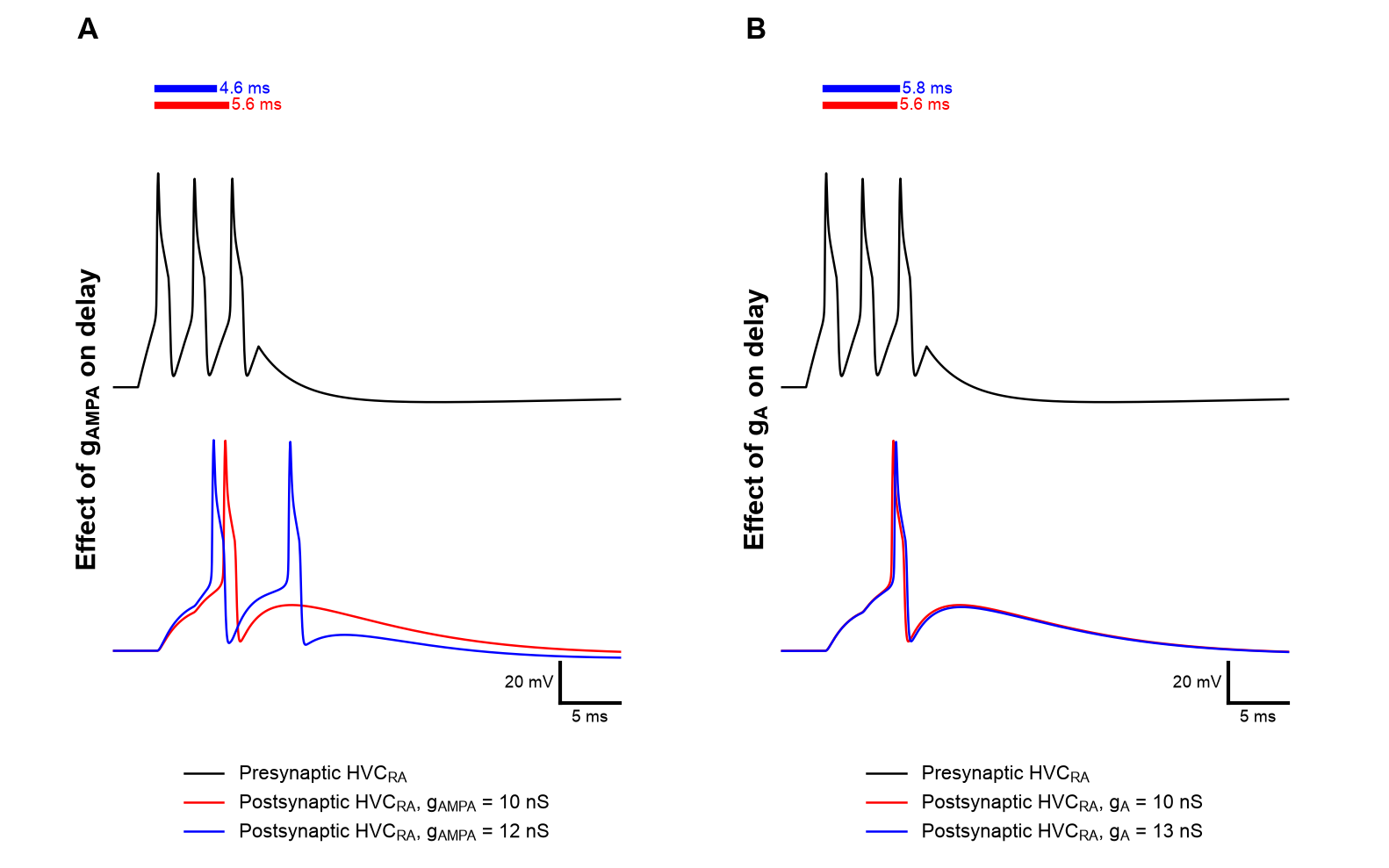
HVC is the premotor nucleus that drives the precise timing of zebra finch song. Bou Diab, Chammas & Daou (2025, eLife 14:RP105526) proposed a conductance-based network of its three neuron classes (HVC(RA) projection neurons, HVC(X) projection neurons and interneurons) to explain how a stereotyped sequence of activity propagates through it. This project is an independent replication of that model.
Methods
- Hodgkin–Huxley-type neurons. Each cell class is a conductance-based model with its own set of ionic currents, connected by AMPA and GABA synapses according to the paper’s wiring rules.
- Reusable Python library. The model is written as a small library, with the network wiring given as declarative specifications. Simulations use SciPy’s adaptive RK45 solver (the same method as MATLAB’s ode45), checked against a fixed-step RK4 integrator.
- A second, independent implementation. The model was also rebuilt in Brian2, and both versions give the same results.
- Many random networks, not one. Each result is tested across many randomly wired networks (for example 50 networks for sequence propagation), together with robustness and numerical checks.
Findings
- Reproduced: the HVC(RA) chain. In 50 of 50 random networks, activity propagates through all 120 HVC(RA) neurons in order.
- Not reproduced from the published description: the HVC(X) rebound bursts, the dense interneuron firing, the calibration of cell pairs, and the fragility results of the perturbation experiments.
- Every gap, typo and modelling choice is documented in the repository’s issues log.